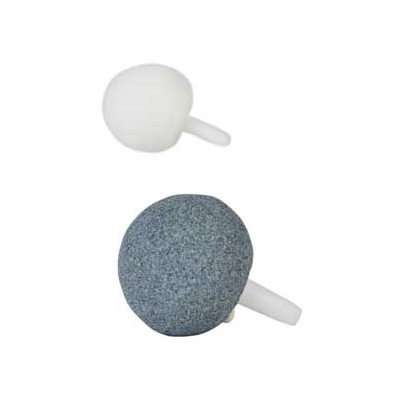
Diffuser (Air stone)

An Ozone Diffuser is a specialized device used to disperse ozone gas into liquid streams — typically water — as fine, uniformly distributed bubbles. By creating a large gas–liquid interface, ozone diffusers dramatically improve ozone mass transfer and dissolution efficiency, enabling the oxidant to react more effectively with contaminants, microbes, colorants, and other target compounds.

Widely used in municipal and industrial water treatment, wastewater oxidation, aquaculture systems, cooling tower sanitation, food and beverage wash water processes, and other ozonation applications, ozone diffusers are key components of systems that rely on effective ozone uptake for superior oxidation performance.

Core Technology & Data

Working Principle

Ozone diffusers operate by breaking ozone gas into fine bubbles — often in the range of micrometers to millimeters in diameter — as they enter the water stream. Smaller bubbles have a greater surface area-to-volume ratio, which:

  • • Increases the gas–liquid contact area
  • • Prolongs the residence time of ozone in the liquid
  • • Improves ozone transfer efficiency
  • • Reduces un-dissolved ozone (off-gas) losses

This hydrodynamic effect enhances ozone absorption, accelerates oxidation reactions, and improves overall system performance without requiring significant additional energy input.

Design & Construction

Typical ozone diffusers are made from ozone-resistant materials — such as:

  • • Porous ceramics
  • • Silicone or EPDM in specialized grades
  • • PTFE/Lined components
  • • PVDF or ozone-resistant polymers

These materials withstand continuous oxidative exposure without rapid degradation, ensuring durability and long service life in ozonation environments.

Integration & Application

Ozone diffusers are often installed:

  • • Downstream of venturi injectors or static mixers to further refine bubble distribution
  • • Within contact tanks or reactors for extended ozone–water interaction
  • • At the end of injection lines where fine dispersion is needed before entering large volume chambers

Proper diffuser sizing and placement are selected based on flow rates, ozone dosage, pipe diameter, and treatment objectives, ensuring optimal mixing and performance.

Benefits & Performance Highlights

  1. 1. High Ozone Mass Transfer
    By generating fine bubbles, ozone diffusers increase the surface area for gas–liquid interaction, leading to higher dissolved ozone levels and more effective oxidation per unit of ozone injected.
  2. 2. Enhanced Oxidation Efficiency
    Greater ozone uptake supports stronger oxidation reactions, enabling deeper disinfection, organic breakdown, color removal, and odor control in treated water.
  3. 3. Reduced Off-Gas & Waste
    Efficient diffusion minimizes un-dissolved ozone leaving the water as off-gas, improving system safety and reducing the burden on ozone destruct or off-gas treatment systems.
  4. 4. Versatile System Integration
    Ozone diffusers work seamlessly with:
    • • Venturi injectors
    • • Static mixers
    • • Contact tanks and chambers
    • • Monitoring and control systems

    …making them adaptable to a wide range of ozonation configurations.

  5. 5. Durable, Ozone-Resistant Materials

    Constructed from engineered materials that resist oxidative degradation, ozone diffusers maintain performance and structural integrity even under continuous duty cycles.

  6. 6. Improved Treatment Outcomes

    Applications benefit from:

    • • Better microbial inactivation
    • • Higher oxidation of contaminants
    • • More consistent water quality results
    • • …thanks to improved ozone utilization.
  7. 7. Energy-Efficient Operation
    Passive diffusion relies on existing flow energy and bubble mechanics — no moving parts or auxiliary power are required — keeping operating costs down compared to mechanical gas dispersers.
  8. 8. Scalable Performance
    Diffusers are available in various sizes and configurations to match system scales from pilot and small-scale units up to large industrial ozonation trains, supporting flexible deployment.

⚠️Important Safety Consideration:
For best results, ozone diffusers should be sized and placed based on flow characteristics, contact time requirements, and ozone dosage. Careful system design — including degassing or off-gas destruction where needed — helps prevent ozone exposure in workspaces and ensures compliant, safe operation.

ozone diffuser ozone water diffuser fine bubble ozone diffuser ozone gas dissolution device industrial ozone diffuser ozone aerator ozone mixing diffuser ozone oxidation equipment dissolved ozone enhancer ozone bubble diffuser